Platform Buildout · Secure Infrastructure
Secure Infrastructure Buildout
Security configurations that "we'll fix later" don't get fixed. They get audited.
Isolated workspaces. Private endpoints. Infrastructure as code from day one.
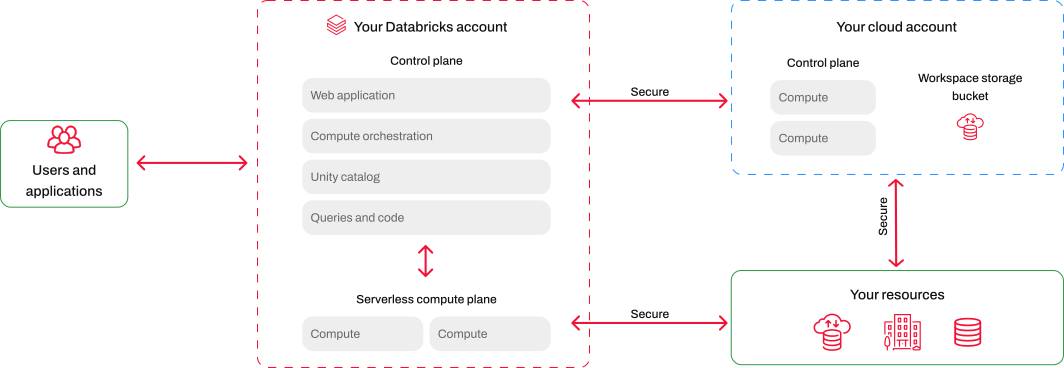
Network isolation by design.
All workspace traffic routes through private endpoints, with no exposure to the public internet. VPC and VNet configuration, subnet design, and security groups are defined in Terraform and consistent across workspaces.
Three workspaces. Same modules.
Development, staging, and production are provisioned from the same Terraform modules, not separately maintained configurations that drift. Infrastructure changes are tested in development and staging before they reach production.
Auditable from day one.
Every infrastructure resource is defined in version-controlled Terraform code, so who changed what, when, and why is traceable through Git history. Compliance questions about infrastructure can be answered with a terraform plan and a diff.
Five phases.
Infrastructure your team can deploy, audit, and extend.
Security and compliance requirements defined across Azure or AWS, covering network topology, identity management, Databricks workspace configuration, and alignment with your compliance framework, whether ISO 27001, SOC 2, GDPR, or internal requirements.
Development, staging, and production workspaces designed alongside the security architecture. Reviewed and approved before Terraform development begins, and kept as a permanent reference for your team.
Reusable Terraform modules for your cloud and Databricks setup, documented inline and in a companion architecture guide. Built for your team to deploy and extend, not locked to Datapao tooling or proprietary abstractions.
Infrastructure deployed across all three workspaces, reviewed and signed off with your team before handover.
Architecture reference, Terraform module guide, deployment runbook, and security control documentation, building on the knowledge transfer that happens throughout.
Common questions before getting in touch.
Can you deliver on-site or does it have to be virtual?
Both. Every programme can be delivered in-person at your location or virtually — globally. The format is agreed during the design phase and has no impact on content depth or lab access. Several tracks are delivered both ways on different engagements simultaneously.
Do participants receive a Databricks certification after the training?
Participants receive a Datapao certificate on completion of any programme. This is a Datapao-issued credential, not an official Databricks certification. However, all programmes aligned to the Databricks Academy official curriculum are designed to prepare participants for official Databricks certification exams, which participants can then sit independently. Many do.
Can you tailor the content to our specific tools, stack, or industry?
Yes — every engagement is private, so all content can be calibrated to your environment. For standard ILT tracks, this means adjusting examples, labs, and exercises to reflect your Databricks workspace and data architecture. For Custom Courseware engagements, it means building the entire programme from your specific requirements from the ground up.
Is training available for non-technical teams, not just engineers?
Yes. The Data & AI for Business Leaders track is designed specifically for executives and senior decision-makers with no data or engineering background. Complex Enablement Programs also routinely span both technical and non-technical audiences within a single programme, combining different content formats and depth levels across personas.