
Optimization & Troubleshooting
Fix Databricks performance issues at the source.
When your Databricks platform needs more than a quick fix
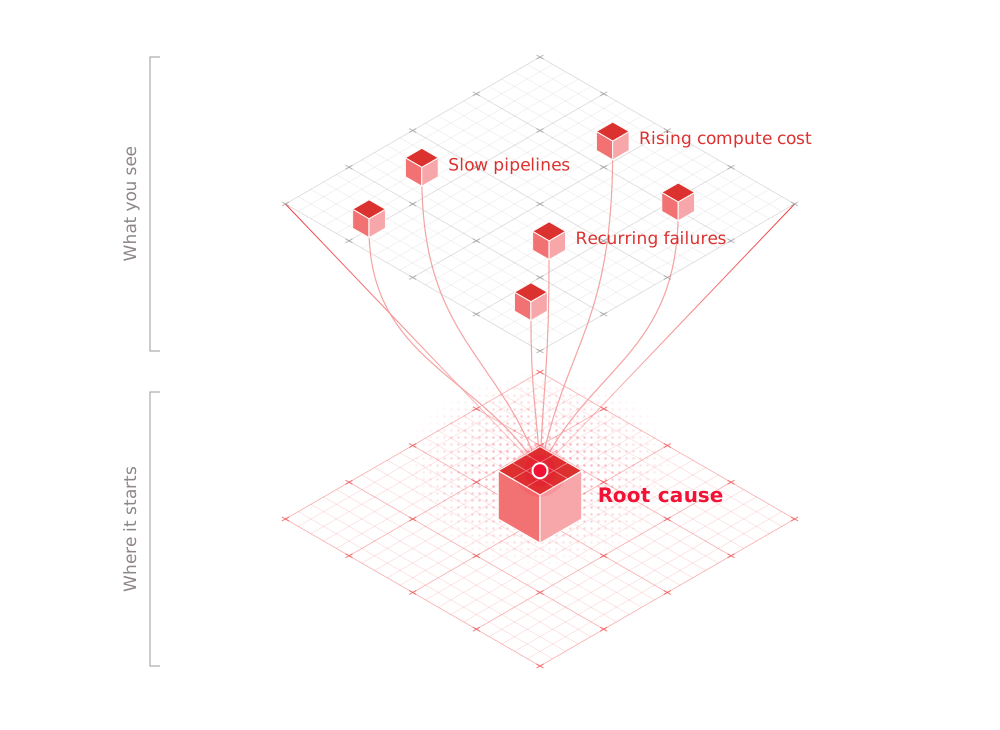
Performance degradation
Pipelines that ran in two hours now take six. Execution times have increased without an obvious trigger. The root cause is structural, not something a LIMIT clause will solve.
Compute costs out of control
Costs are climbing faster than usage. Clusters are running longer than they should. Jobs that should be cheap are expensive. The spend doesn't map to the work being done.
Recurring job failures
A specific pipeline fails every few days. Restarts work, but the underlying cause isn't resolved. The failure pattern is consistent enough to be structural, but nobody has traced it back to root cause.
Where Databricks performance issues usually begin
Pipeline Performance
Slow batch jobs, inefficient transformation logic, poor partition strategies, excessive shuffles, and suboptimal Delta reads. We trace execution back through Spark plans and Delta logs to find where time is being lost and fix it at the source.
Compute Cost Overrun
Cluster configurations that don't match workload patterns, jobs that over-provision, autoscaling that doesn't scale down, and idle compute that accumulates cost. We map actual spend against actual usage and restructure the compute model to match the work.
Job Reliability & Failure Patterns
Recurring failures with inconsistent error messages, jobs that succeed intermittently, race conditions in dependent pipelines, and timeout behaviour under load. We reproduce the failure pattern and trace it to structural cause rather than patching the retry logic.
Streaming & Real-Time Workloads
Latency issues in Structured Streaming, checkpoint problems, throughput bottlenecks, and state management failures. Streaming failures are often opaque, we work from the Spark and Delta logs to surface the actual constraint.
Delta Lake & Storage
Tables still laid out with legacy partitioning or Z-ordering, clustering keys that don't match how data is queried, and maintenance that's either manual and falling behind or was never set up at all. We correct the layout and apply the changes needed for maintenance to run automatically, so performance doesn't drift again.
Unity Catalog & Access Issues
Permission errors that block downstream jobs, lineage gaps, governance configurations that restrict legitimate access, and catalog structures that create maintenance overhead. Access problems in Unity Catalog often surface as pipeline failures with misleading error messages.
Root cause documented.
Fix discovered.
A documented explanation of the specific cause of each problem found: what is happening, where in the platform it originates, and why standard monitoring didn't surface it earlier. Named, scoped, and written for your technical team, not a summary for leadership.
A specific account of what was changed, why, and what it resolves. Where fixes require your team's implementation (e.g. code changes in managed repositories), the exact specification and review notes are included, not a description of what should be changed.
Pattern documentation for each root cause: what to watch for, how to detect it early, and what configuration or maintenance practice prevents recurrence. Written into your platform's documentation, not left as a separate attachment.
A working session with your technical team to walk through what was found, what was fixed, and what to monitor going forward. Questions are answered in the environment, not from slides. The team leaves knowing the platform, not just knowing that it was fixed.