

When we ski down a perfectly groomed slope in the early morning, we rarely think about the streams of data pulsing behind the scenes.
For TechnoAlpin – the global leader in snowmaking technology – data is at the heart of everything. Their machines power ski resorts and international winter events, operating across vastly different climates and geographies. Every day, hundreds of thousands of data points are collected: from weather stations perched high in the mountains, to IoT sensors inside pumps and nozzles, to energy and water consumption meters. With their digital transformation already underway, TechnoAlpin partnered with Datapao to accelerate progress and build a platform ready for the next decade of innovation.
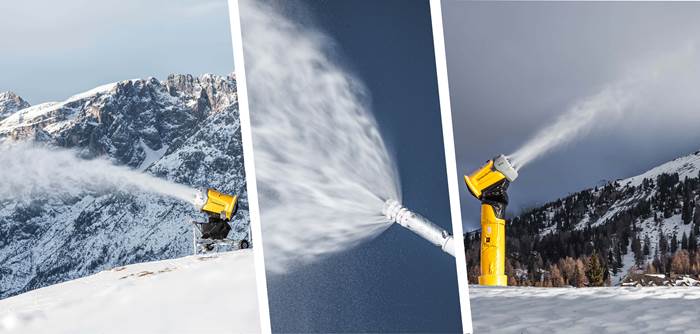
TechnoAlpin’s digital evolution
TechnoAlpin has long been a pioneer in snowmaking systems, manufacturing snow guns, lances, pumps, control systems, and designing full turnkey snowmaking installations.
Over time, they realized that hardware and control logic alone would no longer suffice. As climate variability grows, energy costs rise, and sustainability becomes more important than ever, TechnoAlpin recognized that true differentiation would come from data-driven decision-making and predictive capabilities.
One key pillar in their digital stack is ATASSpro, their control and automation system for snowmaking. Through ATASSpro, they monitor operations of snow machines (fan guns, lances, central systems), track utilization, machine hours, water consumption, and other operational metrics.
Complementing that, TechnoAlpin developed SnowMaster, a management and decision-support software accessible via web interfaces. It ingests data from ATASSpro, merges meteorological forecasts, and provides an integrated view of snow production planning, resource utilization, and energy indices.
Some technical capabilities of SnowMaster:
- Real-time access: Track gun usage, total snow produced, which guns are active, etc.
- Forecasting: Using weather projections and past performance, estimate how much snow can be produced in the coming days, and what water input is needed.
- Energy indexes: SnowMaster monitors energy consumption by different system components (pumps, compressors, water supply, etc.) and offers “energy indexes” (e.g. kWh per cubic meter of snow, or per water usage) to allow tracking efficiency.
- Cross-device access & visualization: it’s browser-based and offers maps/3D visualizations of slope states, gun positions, snow depth, etc.
- Customization & segmentation: It breaks down data by altitude zones, slope groups, and site-specific configurations, giving operators flexibility.

In short:
TechnoAlpin has already built a sophisticated digital backbone. But like many companies, their architecture had limitations.
TechnoAlpin started to build out its data infrastructure on Microsoft Azure as early as 2018, adopting Azure Synapse Analytics to create a foundation for cloud-native data processing. Their primary motivations were to handle growing data volumes more efficiently and future-proof their platform for advanced analytics and machine learning use cases. However, as their data volumes and operational complexity grew, their initial Azure Synapse-based implementation began to show limitations. They faced challenges with near-real-time data processing, pipeline scalability, and centralized governance, which made it difficult to deliver timely insights and support advanced analytics initiatives.
To overcome these constraints, TechnoAlpin decided to migrate to Databricks because it could provide a truly unified Lakehouse architecture, robust data engineering capabilities, production-ready workflows, and fine-grained governance.
Where Datapao came in
As Databricks adoption became a clear strategic goal for TechnoAlpin, they sought specialist guidance on their initial implementation. They partnered with Datapao to modernize their Databricks environment and ensure it was production-ready, scalable, and aligned with best practices. The first step on this journey was a comprehensive architecture review.
1. Discovery & Architecture Review
Following several technical discovery sessions, Datapao delivered a comprehensive architecture review, pinpointing opportunities to optimize data engineering workflows, accelerate data validation, and improve compute efficiency. The engagement provided actionable insights and tailored architectural recommendations aimed to support TechnoAlpin’s long-term data strategy objectives.
The assessment of TechnoAlpin’s Azure + Databricks data architecture covered the following topics:
- Data ingestion and processing patterns from core operational systems
- Approaches for handling streaming and near-real-time data
- Data storage and table design strategies
- Orchestration and lifecycle management of data pipelines
- Analysts’ and data teams’ ways of working
- Foundations for machine learning experimentation and serving
- Data serving layers for SnowMaster and internal applications
- Environment separation across development, staging, and production
- Governance and catalog management
This analysis revealed improvement areas and modernization opportunities that formed the foundation of the desired target state for the data platform.
2. Planning & Lakehouse Design
Building on the findings of the discovery phase, Datapao worked with TechnoAlpin to design a simplified, future-proof lakehouse architecture that could scale across business units, use cases, and teams. This phase focused on defining clear governance, data structures, and architectural patterns that would reduce complexity while enabling advanced analytics and real-time use cases.
- Data governance model
- Unity Catalog structure
- Workspace isolation and cross-workspace access control
- Revised medallion architecture
Datapao proposed a unified, simplified lakehouse architecture fully based on Delta Lake:
- Bronze → land raw Event Hub data directly in Delta
- Silver → clean, enriched entities with consistent schema
- Gold → business-ready datasets served to SnowMaster, internal tools, and SQL endpoints
This design reduces complexity, storage cost, duplication, and manual work, and provides a reliable ground for geospatial analytics, ML, and real-time use cases.
3. Infrastructure & Data Governance
With the target architecture defined, the next step was to establish a solid, consistent platform foundation. This phase focused on standardizing environments, access controls, and naming conventions to ensure the lakehouse could be operated securely and efficiently at scale.
- Workspace deployment
- Naming conventions
- Catalogs, schemas, storage credentials, external locations
- Access control models and role-based permissions
- Alignment of business areas, data domains, medallion architecture
4. Lakehouse Development
Datapao then supported the implementation of the core lakehouse components, focusing on performance, maintainability, and simplicity. The objective was to turn architectural principles into reusable, production-grade data pipelines and patterns that teams could build on confidently.
- Performance optimizations and resource efficiency
- Simplification of orchestration and pipeline operations
- Reusable shared components and libraries
- Handling evolving and semi-structured data formats
- Configurable transformation patterns within the lakehouse
- Support for both batch and streaming data processing
- Migration of analytical workloads to the lakehouse
5. Production-readiness (CI/CD, testing, monitoring)
To move from experimentation to reliable daily operations, Datapao helped TechnoAlpin introduce robust engineering practices. This phase ensured that data pipelines and infrastructure could be deployed, tested, monitored, and operated safely in production environments.
- Automated testing strategies
- Built automated CI/CD pipelines in Azure DevOps
- Separated CI (build/validation) and CD (deployment) workflows
- Automated Terraform deployment for infrastructure
- Introduced versioned, immutable deployments for production readiness
- Monitoring, alerting, and operational visibility
6. Enablement
Beyond technology, long-term success depended on TechnoAlpin’s teams being able to own and evolve the platform themselves. Datapao therefore focused on hands-on knowledge transfer, enabling data engineers to understand not just what was built, but why and how to extend it.
- Mid-engagement knowledge sharing sessions about Databricks features or solutions
- Iterative hands-on small task-based enablement (co-implementation) for data engineers to understand how the solution/feature works → hands-on experience, no blackbox implementation
7. Governance, quality & lineage
As TechnoAlpin operates across many sites and countries, strong governance and data quality controls were essential. This phase focused on making data trustworthy and transparent, so insights, dashboards, and models could always be traced back to their source. Datapao helped solidify governance using Databricks Unity Catalog:
- Role-based access, policies, and column-level restrictions for sensitive data (e.g. pump telemetry).
- Data lineage tracking so that when dashboards or models show a number, one can trace it back to raw sensors.
- Monitoring & alerts for data quality issues (missing data, outliers, sensor drift).
8. Operationalization & change enablement
Finally, Datapao supported the organizational and operational transition required to embed the new platform into everyday workflows. This phase ensured that new capabilities were adopted in practice, not just implemented technically. Datapao’s consulting supported:
- Training for TechnoAlpin’s snowmaking engineers and data scientists to use new tools, pipelines, and models.
- Change management to phase out redundant manual processes.
A partnership built on clarity and momentum
TechnoAlpin already operates one of the most advanced digital ecosystems in the snowmaking industry. Partnering with Datapao helped them gain a clear, modern, future-ready architectural direction. One that strengthens their platform, reduces technical complexity, and opens new possibilities for real-time insight, scalability, machine learning, and AI-powered customer support.
For Datapao, supporting TechnoAlpin is a privilege: working with a visionary engineering company whose products shape winter experiences for millions around the world.
Together, we are building the next generation of intelligent snowmaking.