End-to-end AI Engineering

Production-ready AI,
built on Databricks.

Assistants, RAG, agentic systems, internal copilots, and workflow automation, designed for production from day one. Every system inherits the governance, security, and data quality controls of your Lakehouse rather than bolting them on afterwards.
The Problem

Anyone can build an AI demo in an afternoon. Only a few ships one that survives production.
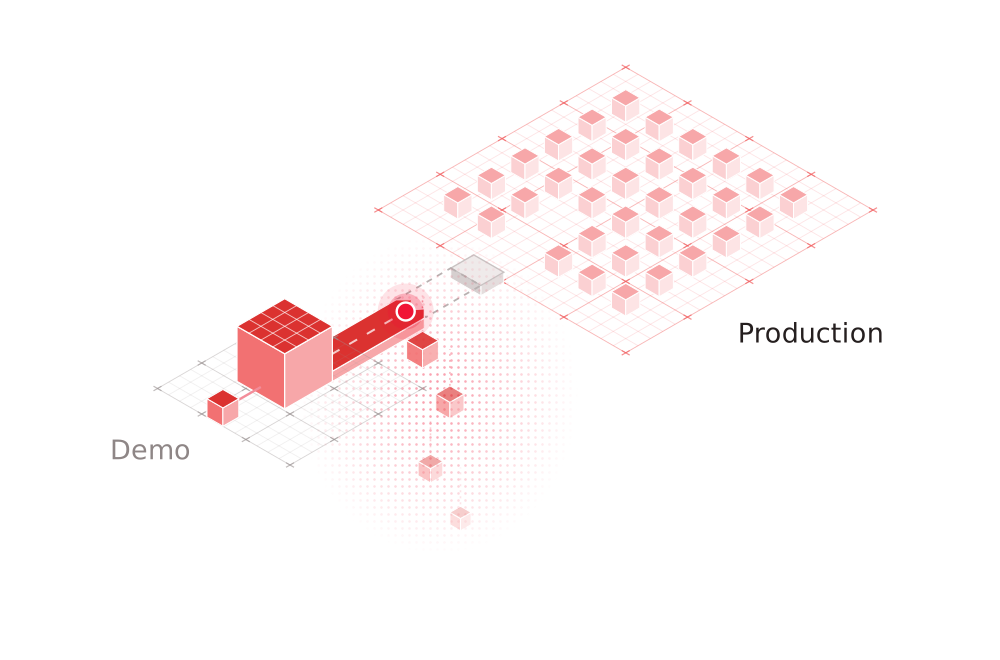
That gap is where most AI initiatives die, quietly, after the initial excitement fades. The cause is rarely the model. It is poor structure, unclear evaluation, unscalable architecture, fragmented tooling, or weak governance. A chatbot that works in a sandbox falls apart under concurrent users. A RAG system that answers correctly in a demo hallucinates in production, because nobody built retrieval quality evaluation in from the start.
Our Approach

AI built to become part of your business

Engineered for production from day one, not retrofitted for it after a successful demo. Everything we build sits natively inside the Databricks Lakehouse, which means your AI applications inherit the platform's governance, security, and data quality controls automatically.

That is the difference between an AI feature and an AI system your business can depend on.

01

Governance built in, not bolted on

Building natively on the Lakehouse means access control, lineage, and data quality are properties of the platform rather than a separate workstream. Unity Catalog governs the data the model sees the same way it governs the data the business sees. There is no second security model to maintain and no parallel stack to audit.

Unity Catalog
One audit trail
No parallel stack
02

Evaluation designed in, not added after

Quality criteria are defined before the build starts, and structured evaluation runs against them throughout. Automated judges score outputs against criteria your domain experts set, so "is it good enough" becomes a measurable question with a documented answer instead of a matter of opinion in a review meeting.

Structured evaluation
Retrieval quality
Human in the loop
03

Your team operates it when we leave

Structured knowledge transfer runs throughout delivery rather than as a handover phase at the end. The engagement is complete when your team can operate, extend, and govern the system independently, not when the code is committed.

Knowledge transfer
Runbooks
Operational independence
What We Build

Five build types. One architecture underneath them.

Most engagements start with one of these and grow into a second. They share the same governed foundation, so adding the next one is a configuration decision rather than a new platform decision.
01 · Conversational
AI Assistants & Chatbots
Conversational interfaces grounded in your company's actual data and policies. We build AI assistants that cite their sources and escalate to a human when confidence is low, rather than confidently guessing.
Built for
Internal helpdesks, customer-facing support, employee self-service.
02 · Retrieval
RAG (Retrieval-Augmented Generation)
Systems that retrieve accurate, current information from your internal documents and databases, and ground every answer in that retrieved context with traceability back to the source document. We design the retrieval pipeline, meaning chunking strategy, embedding choice, and ranking logic, around your actual content rather than a generic template, because retrieval quality is where most RAG systems quietly fail.
Built for
Knowledge management, compliance Q&A, technical documentation search.
03 · Deepest capability
Agentic AI
This is where Datapao's deepest expertise sits. Rather than relying on a single model to handle every request, our agentic systems work like a coordinated team of domain experts. An Orchestrator Agent analyses each request to determine whether it is a simple lookup or a complex multi-step task, decides the approach, and either runs it directly or breaks it into subtasks assigned to specialised agents.
The difference shows in the answer. Instead of "sales dropped in Q3", the system can uncover why, tying together CRM logs, marketing spend, supply chain delays, and customer feedback into one coherent, traceable narrative.

End-to-end governance runs through Unity Catalog, with secure orchestration via Mosaic AI and AI Gateway. The architecture is modular enough to configure agents for specific departments, so finance, operations, or customer experience can each get a domain-specialised deployment in less than a week.
Orchestrator Agent
Mosaic AI
AI Gateway
Unity Catalog
Built for
Complex enterprise decision support where a single-model chatbot isn't enough.
04 · Embedded
Internal Copilots
AI tools embedded directly into the workflows your employees already use, putting institutional knowledge in front of the people who need it at the moment they need it.
Built for
Sales enablement, engineering support, onboarding, analyst workflows.
05 · Automation
Workflow Automation
AI woven into existing business processes to remove manual, repetitive steps such as document review, data entry, triage, and classification, while keeping a human in the loop wherever judgment or accountability matters.
Built for
Operations teams carrying manual processing that no longer needs to be manual.
How It Works

From use case to production, with quality built in.

Iterative delivery with regular checkpoints rather than a black-box six-month build. The scope is defined upfront and the architecture is approved before development starts.
step 01
Scope
Define the use case, the success metrics, and the data sources. If the use case is not yet chosen, this runs as an AI Strategy and Advisory engagement first.
step 02
Architect
Design the solution on Databricks, with governance and evaluation designed in at this stage rather than added at the end. Reviewed and signed off before build begins.
step 03
Build
Iterative development with regular checkpoints. Data pipelines, retrieval and agent logic, integrations, and the surfaces your users will actually touch.
step 04
Evaluate
Structured, measurable evaluation against real quality criteria before anything reaches production. Automated judges score outputs against criteria your domain experts define.
step 05
Deploy and Enable
Production rollout paired with knowledge transfer, so your team can operate and extend the system independently. Monitoring, escalation paths, and ownership are defined before go-live.
Results

What migrations deliver in practice

TechnoAlpin

From snow guns to smart systems: TechnoAlpin’s data transformation with Datapao

When we ski down a perfectly groomed slope in the early morning, we rarely think about the streams of data pulsing behind the scenes.
Timeline
Unified data platform live in under 12 weeks
Enablement
Internal team fully enabled to operate independently
Performance
60% reduction in pipeline processing time
Read the whole study
Manufacturing
Good to Know

Common questions before building production AI.

What types of AI applications can you build on Databricks?

We develop enterprise AI assistants, RAG systems, agentic AI solutions, internal copilots, and intelligent workflow automation. Whether you need a knowledge assistant grounded in company data, specialised agents handling complex tasks, or AI embedded into business processes, we design the solution around your actual requirements rather than forcing a particular technology.

Do we need agentic AI, or would a simpler AI solution work?

Not every problem needs a team of AI agents. Sometimes a well-designed RAG system or a straightforward automation delivers better results with less complexity and lower operating costs. We assess your use case, data, and business requirements before recommending an architecture. If agentic AI adds genuine value through multi-step reasoning, orchestration, or specialised tasks, we'll show you where and why.

Can your AI solutions integrate with our existing business applications?

Yes. We build AI systems that connect to your existing data sources, APIs, enterprise applications, and business workflows. Whether you're integrating with a CRM, internal knowledge base, operational system, or employee-facing application, we focus on making AI useful within the tools and processes your teams already rely on.

What happens after the AI application goes live?

We make sure your team can operate what we've built. Every engagement includes documentation, knowledge transfer, and operational handover. We can also provide continued engineering support as your requirements evolve, but our goal is to leave you with a system your organisation can confidently own and extend.