
Platform Buildout · CI/CD
CI/CD Buildout
End-to-end CI/CD implementation for Databricks: automated testing and deployment across development, staging, and production workspaces, designed for how data teams work. Every change your team makes follows the same tested path to production.
The Problem
Manual deployments don't fail all at once. They fail quietly, until the day they fail loudly.
Most data engineering teams start with ad-hoc deployment patterns: notebooks pushed directly, scripts run manually, and changes coordinated through Slack. It works at first. Then the team grows, the complexity grows, and the gap between how things should work and how they actually do grows with it.
Deployments Hit Production Untested
"It worked in dev. Now it's broken in production."
Manual notebook pushes with no staging validation mean one bad change can break downstream jobs and dashboards. The team only discovers the error once something stops working.
Environments Drift Apart
"We're not sure dev and production are running the same version anymore."
Without version control and automated deployment, development, staging, and production environments diverge over time. Configuration differences accumulate, and the same issues keep coming back as incidents.
No Rollback Path
"Something broke. We don't know which change caused it, and we can't easily revert."
Manual deployments leave no reliable audit trail. When a production incident occurs, finding the change that caused it takes detective work, and reverting it means manually redeploying the last known good state.
The Architecture
Source to production.
Automated at every step.
The CI/CD architecture Datapao implements keeps development, staging, and production environments separate, automates every step between them, and promotes each change through a controlled process with automated testing along the way. Nothing reaches production just because someone with access pushed it manually.
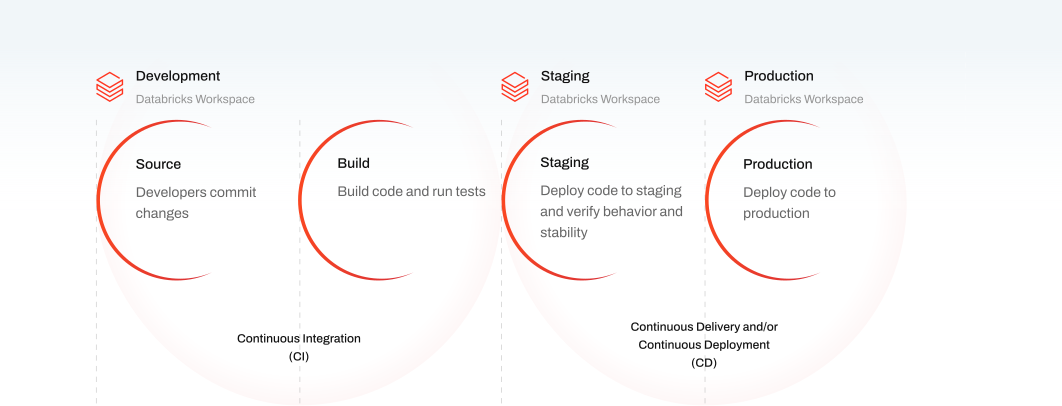
Separate environments. Always.
Development, staging, and production are separate Databricks workspaces, not modes or flags. Changes can't reach production without passing through staging.
Automated gates. Not manual approvals.
Every promotion from development to staging, and from staging to production, is gated by automated tests. A change that fails testing doesn't advance.
Everything version-controlled. Every change traceable.
Pipeline code, infrastructure configuration, workspace definitions, and deployment scripts all live in Git, so every change can be traced and every state can be restored.
What's Delivered
Six phases.
A CI/CD setup your team owns.
Each phase builds on the last, resulting in a CI/CD setup designed around how your team works.
01
Requirements Assessment
Requirements gathering covering your team's workflows, tooling, branching strategy, and testing needs. Clear scope before design begins.
02
CI/CD Architecture Design
A CI/CD design tailored to your Databricks setup: branching strategy, promotion rules between workspaces, testing strategy, and deployment automation. Designed around your team size and workflow, not a generic reference.
03
Pipeline Implementation
Automated pipelines for integration, testing, and deployment, promoting changes across your development, staging, and production workspaces.
04
Test Examples
Unit, data, and integration test examples implemented as working tests against your actual pipelines, not a framework for your team to fill in themselves.
05
Validation
A complete deployment cycle run through every stage of the pipeline, reviewed and signed off with your team before the engagement closes.
06
Handover and Enablement
Architecture documentation, runbooks, and deployment playbooks, with knowledge transfer throughout on how the setup works, how to extend it, and how to debug common failures.