


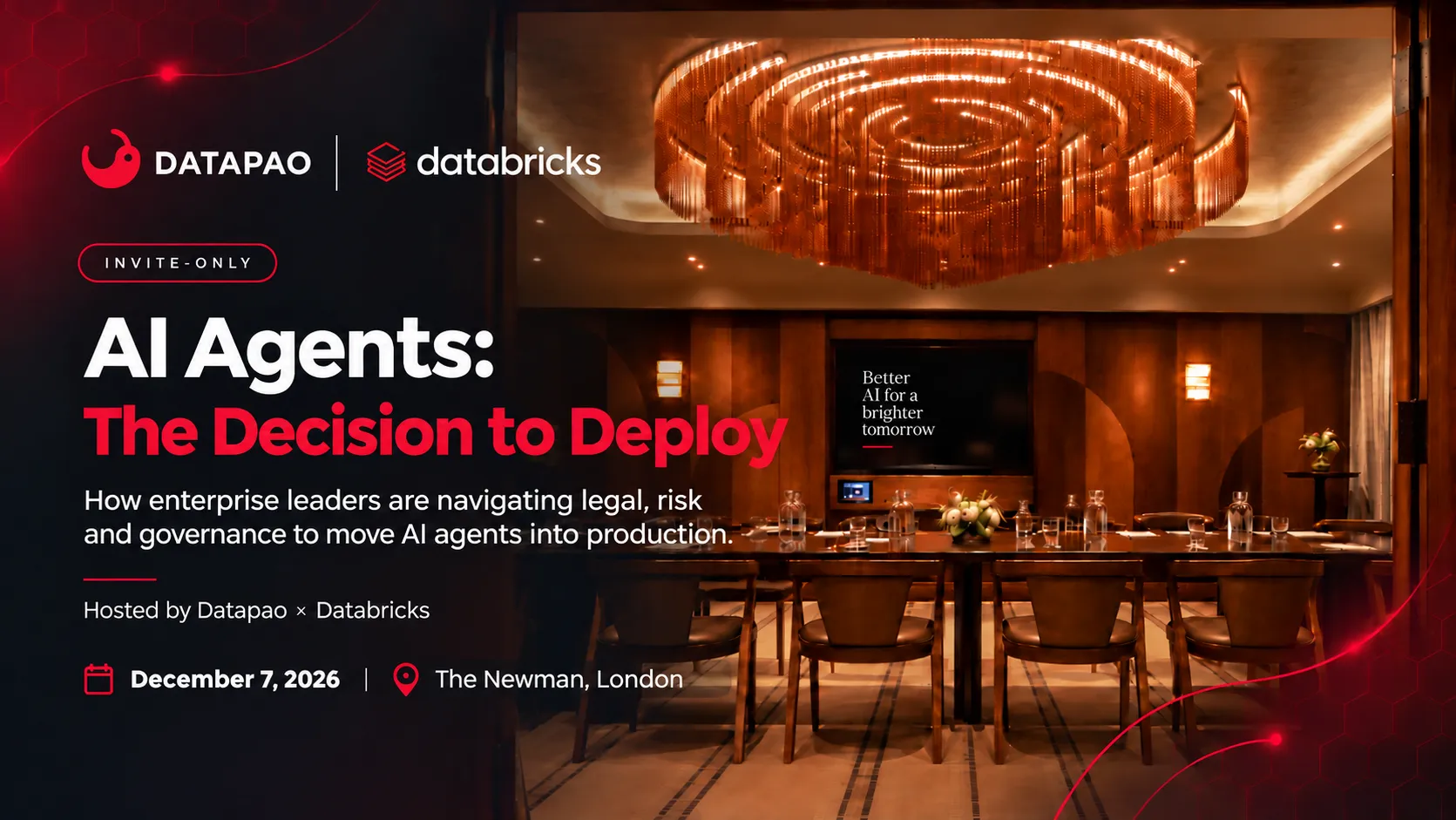
The next challenge in Enterprise AI isn't building agents. It's deciding to deploy them.
Enterprise AI agents are moving beyond experimentation, but getting them approved for production remains a challenge.
An agent might perform well in testing and have a clear business case, yet still face months of internal reviews. Legal teams need to understand the regulatory implications. Security teams want assurances about data access and information leaving the organisation. Risk teams need to establish who is accountable when something goes wrong.
These are reasonable concerns, but resolving them isn't always straightforward. Particularly when regulations are evolving, responsibilities are spread across departments and existing approval processes weren't designed for autonomous AI systems.
How are enterprises addressing these challenges, and what has helped them move from stalled projects to approved deployments?
A private conversation on how enterprises are moving forward
In December, Datapao and Databricks will bring together a selected group of senior executives at The Newman in London for a private discussion on the decisions shaping enterprise AI agent deployment.
The roundtable will examine how organisations are navigating legal, security and governance requirements, where approval processes tend to break down, and what has enabled others to move forward.
Moderated by Máté Gulyás, CEO of Datapao, the conversation will bring together perspectives from enterprise technology leadership, Databricks and legal expertise.
Rather than discussing governance principles in isolation, we'll focus on actual deployment challenges and the approaches organisations have taken to resolve them.
The objective is to understand not only what good governance looks like, but how organisations are making it work in practice.
The session will be held under the Chatham House Rule.

What we'll discuss
1. Getting legal approval while regulations evolve
UK and EU approaches to AI regulation are developing at different speeds, leaving organisations to make deployment decisions without complete regulatory certainty.
How are legal teams determining which use cases can proceed? What level of documentation, risk assessment and oversight is sufficient? And how can organisations establish policies that remain workable as requirements change?
We'll discuss the use of risk-based classifications, common approval standards and regular policy reviews, and how these approaches have worked in practice.
2. Managing sensitive data in AI interactions
AI agents may process personal information, confidential business documents and data retrieved from internal systems. The involvement of external model providers introduces further questions around data processing, storage and retention.
We'll examine how organisations are managing these risks, including the use of AI gateways, data masking, vendor agreements and controls over where information is processed.
The discussion will consider which safeguards have been necessary to secure internal approval and how organisations verify that those safeguards are effective.
3. Controlling what AI agents can access
An AI agent connected to enterprise systems needs access to information to perform useful work. Establishing the appropriate boundaries for that access is a significant security and governance consideration.
We'll explore how organisations are implementing identity-based permissions, enforcing access controls through existing data platforms and ensuring agents cannot retrieve information beyond a user's authorisation.
We'll also discuss how these controls are tested and demonstrated to security and risk teams before deployment.
4. Establishing clear ownership and approval processes
AI agent deployments frequently involve multiple stakeholders across Technology, Legal, Security, Risk and the Business. Without clear decision-making responsibilities, approvals can become prolonged or remain unresolved.
We'll discuss how organisations are defining accountability for individual use cases, establishing agreed acceptance criteria and structuring review processes to reach decisions within a reasonable timeframe.
An important part of the conversation will be understanding how different teams have aligned their expectations around acceptable risk.

What participants can expect
The roundtable will be structured around four common barriers to production deployment, but the discussion will be driven by the experiences of those attending.
Together, we'll examine which challenges appear most frequently, how different organisations have approached them and which measures have proved useful.
The aim is to leave with a clearer understanding of:
- The legal, security and governance concerns most frequently delaying AI agent deployments.
- The technical and organisational approaches other enterprises have used to address them.
- Practical measures that could help resolve similar issues within participants' own organisations.
A short, anonymised summary of the key discussion points and approaches will be shared with participants afterwards.
Who should attend?
The roundtable is intended for senior leaders directly involved in enterprise AI deployment and the decisions required to approve it.
This includes Chief Data Officers, Chief AI Officers, CIOs, CTOs, Heads of Data and AI, and senior leaders responsible for AI governance, legal, risk, security and technology transformation.
Participation is limited to approximately 15 executives to allow for a detailed discussion and a meaningful exchange of experiences.
Agenda
TBD