
MLOPS BUILDOUT
An end-to-end automated MLOps pipeline on your Databricks environment.
What the buildout delivers
Fully integrated into your Databricks architecture
An end-to-end MLOps pipeline built using the latest Databricks and open-source features, designed to fit into your existing Databricks environment, not sit alongside it. Fine-grained permissions and access control are part of the setup.
Streamlined ML development
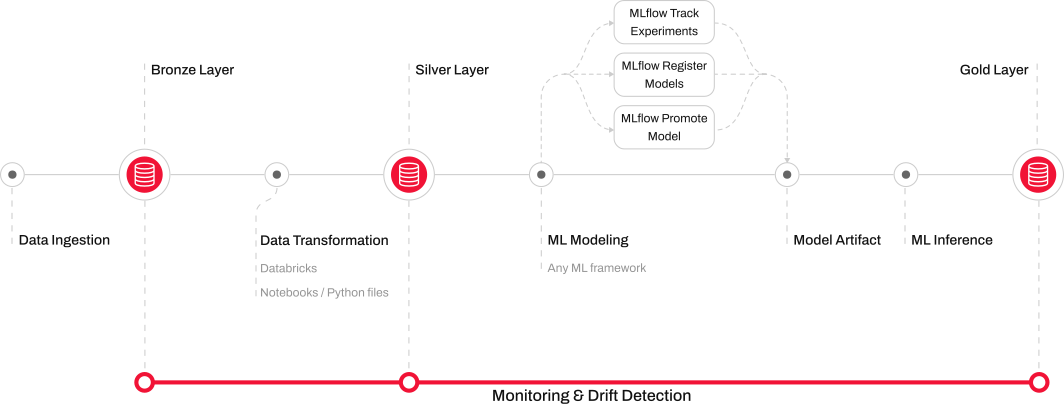
The MLOps framework applies to any ML project in your environment. Data scientists can track and compare experiments, register models, and promote them through stages, without manual handoffs or ad hoc processes.
Faster ML use-case development
Demo use-cases - including data ingestion and transformation - are delivered as part of the pipeline. Your data team can use them as starting points to reduce the time it takes to develop new ML use-cases.
Automated model maintenance
The delivered pipeline includes automatic model retraining. When a model drifts or a retraining schedule triggers, the pipeline handles it without manual intervention from the data team.
The full model lifecycle.
Automated end-to-end.
Four phases. A production MLOps pipeline running on your environment.
- Project planning
- Access provisioning
- Review of existing ML processes
- Pipeline architecture design
- Pipeline setup
- Pipeline validation
- Enablement sessions
- Demonstration
- Documentation
One engagement.
Everything included.
Initial design planning
In-depth analysis of your existing ML processes and Databricks setup before deployment begins so the MLOps pipeline is designed to fit your current architecture, not applied as a generic template.
Data preparation included
The demo use-cases delivered with the pipeline include data ingestion and data transformation steps so your team has working, runnable examples of the full pipeline, not just the modeling stage.
Knowledge Transfer and Handover
Workshops, enablement sessions, and comprehensive documentation so your team can maintain, extend, and troubleshoot the pipeline without needing to re-engage.
ML models in focus
The delivered pipeline covers the full model lifecycle: Modeling, Experiment tracking (MLflow), Model registration, Model promotion, Batch inference, and Model serving for real-time inference. Every stage is included.
Monitoring
The pipeline includes monitoring and drift detection capabilities, plus automatic model retraining so models stay accurate over time without manual intervention from the data team.